
Interview – Hearts Afire: Surviving the 2025 Altadena Wildfire
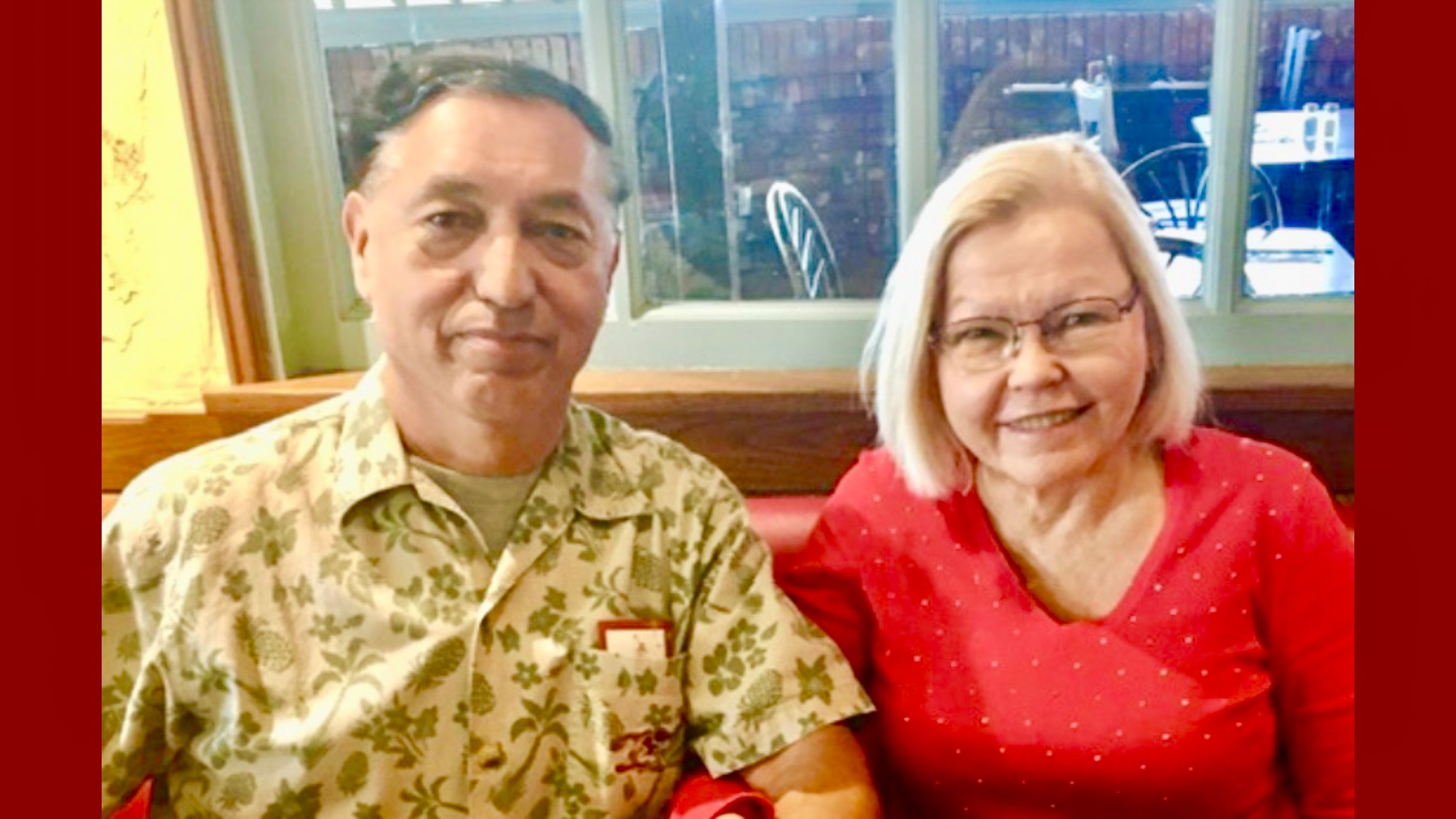
Above is Dorothy Noe and her husband.
Interviewed for T1D100.com by Barbara Giammona, posted May 28, 2026.
She saw it coming closer on social media and the TV News, she heard the howling winds, but she couldn’t imagine that it could reach all the way to her house. So many previous fires had stayed in the foothills and not ventured into the neighborhoods of Altadena, CA. But as a T1D of 61 years, Dorothy Noe smelled, and then saw, the approaching danger. Over a period of hours on January 7 and 8, 2025, she and her husband had to take action. When she evacuated her house that dark, early morning, she never imagined that she’d never return.
I met with Dorothy to hear more about what happened that night and about coping with the aftermath.
Barbara: Tell me about the day of the fire and of the immediate crisis that followed.
Dorothy: You’d think, with where I live, I’d be prepared for an emergency. In fact, previously, in 1993, a fire came close to our house, and we were about to be evacuated. Half an hour later, they changed the order.
But what that prior experience made me realize is I had diabetes supplies all over the house. I started thinking how I could condense and organize everything better. I developed a rotation system where pump and sensor supplies I was using daily were in a single box that I would replenish every 10 days or so from the larger stock of items I had on hand. But still, not quite all of it was together in one place. In my closet, I had stock-piled supplies for my pump from various groups that help people share supplies. I had 15 bottles of insulin in the refrigerator. But I did not have back up pumps, glucagon, or supplies for lows gathered together.
Last year, on the day the fires started in the Los Angeles area, I was working from home and was off at 12:30 p.m. I turned on the news, and I saw that Pacific Palisades (about 35 miles away) was on fire. I got mesmerized watching the coverage of that fire on TV. I was just doing different things around the house. Doing some laundry.
And then I started getting weather notices that the wind event we were having was considered “extreme.” That evening, around 5:30 p.m., I heard that Eaton Canyon, in the mountains near my house, was on fire, too. I thought, “Well, with high winds, it would take maybe a day to get close to where my house is.”
So, I didn’t think much of it. I just kept my eyes on the nearby mountains. I didn’t see anything for quite a while. About 7:30 p.m., the power went out, and the wind sounded like two freight trains going down the street. I began to think, “This is really severe. Maybe I ought to start putting some boxes of supplies at the door.”
I took all of my 15 bottles of stock-piled insulin and put them in my Frio cold pack and left them in the fridge, ready to come with me if we had to leave. Even though the power was out, I knew the fridge would be cold for quite a while.
It was dark, but I could see the fire off in the distance. It got close to us much faster than I imagined earlier in the day. I told my husband to start gathering more things we should take. I grabbed a drawer full of important papers: taxes, trust, recent bills with account numbers. And my computer. My husband grabbed his medical history paperwork. But I hadn’t thought of that.
Next, we started getting pictures out of our hutch and putting them in the car. He got tired, so he went to sleep sitting on our couch. Me, I didn’t get to sleep until three days later!
At 2:06 a.m., I took a picture that showed the fire on the mountain range right behind the hills closest to our house. I got up and started gathering more things to pack. I couldn’t find a flashlight, so I was using the flashlight on my phone to see. By fifteen minutes later, fire was covering the whole space of the previous photo I took.
I said to my husband, “We have to go!”
Did I think my house was going to burn down? No. It was just the fact that the wind was howling and that the fire was moving so quickly. Nearby, I kept hearing car doors slamming and cars starting.
My husband said we should drive around and “check things out.”
I thought he was crazy, but I agreed.
We got in the car. We went around the block. It was terrifying. Chunks of embers were flying through the air like missiles. But, again, do you think I comprehended that I was going to lose everything? No, I never did.
But at least I got my important stuff out. I realized later that I forgot all of my beloved Snoopy’s. I had a cabinet full of Snoopy’s I’d collected going back to the 50s and 60s. He was my special friend and comfort as a child.
After driving around for a few minutes, my husband said, “Yes, I think we’re leaving.” At that point, we couldn’t see the bottom of the fire, because it had already come down the mountain and was behind the houses above ours.
We went back to our house one more – the last – time. And we were grabbing things at the last minute. We put the dog bed in the car.
We have a little nine-pound dog named JoJo. I couldn’t hear him, but he was howling at the top of his lungs. I couldn’t find him. With our dying phone flashlights, we finally found him “hiding” in his toy box. We grabbed him.
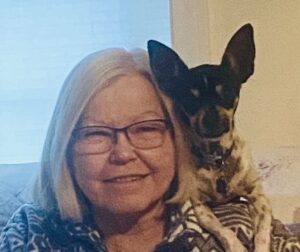
Dorothy + JoJo
My husband remembered our phone chargers and my pump charger. You’d have thought we should have remembered those earlier!
We got in my husband’s car, and I thought, “What about my car?” He went back in for those keys. And at the last minute, he thought of his citizenship papers. He grabbed those.
Now it’s about 3:40 a.m. My husband suggested we drive down the hill to a grocery store we know of and park there, a few miles from home. Maybe we could leave a car there and find a hotel somewhere.
I remember driving down the street, the embers are just flying. By this time, they’re the size of basketballs, zooming past me. And I kept thinking, “Please don’t catch my house on fire! Please don’t catch my car on fire. I can’t carry the dog and all my medical supplies if I have to flee on foot!”
I was following my husband’s car. I thought, “Don’t let my husband hit a downed tree or a power line.” We slowly made it out.
But when we got to the grocery store, it was crazy. There were all kinds of strange people milling around suspiciously, looking for an opportunity to prey upon people like us: people who had fled with “fire brain,” heads full of smoke, staring blankly up at the burning mountain from our cars.
We tried calling nearby hotels, but everything was booked and we did not want to go to the Convention Center, where evacuees were offered a space. Then we finally remembered my daughter’s beach unit in San Pedro, about 40 miles away. We had the keys. And we said, “We’ll go down there and call her in the morning.”
We got on the road. There was nobody on the freeway. Nobody. Yes, it was the middle of the night, but I think because of the wind event, people were simply staying at home.
Barbara: Wow! Thank goodness you found a safe haven!
Dorothy: Yes, but it was essentially a weekend house furnished with basics. A place to party. They had three blenders and lots of coffee makers, but nothing for everyday living!
I was up all night – couldn’t sleep. I was getting information about our street from a firefighter resident who was trying to save his house. And at one point, on that first night, he said, the houses on the west side of the street fared a little bit worse than on the east side.
We lived on that west side of the street. I interpreted that to mean that maybe my backyard burned. No, the houses were gone. The west side of the street was gone, except for one house.
By the time the sun came up, the east side was gone too.
I waited until my husband woke up to tell him. And we just hugged each other and cried.
Barbara: I’m so sorry! What happened next? How did you take care of basic necessities?
Dorothy: The fact was, we had no food. And we would drive 40 miles up to Altadena, where we could get meals provided by an emergency relief kitchen. I would get six meals. My husband would get six. We’d come home and stretch those out a whole week.
The sparse unit didn’t even have a piece of paper or a pen, or any kind of office supplies. I thought I could help my foggy brain by making lists. I found scissors and a pencil in my car. I cut up brown paper bags to make lists of things, but then I couldn’t read what I’d written down!
Our brains were so addled. We ate random things. We got English muffins, cheese, and butter, and we lived off that for breakfast for a few days.
We soon got tired of washing out underwear. But that’s the kind of unfocused things we were doing. We finally went to Costco and got more underwear.
Eventually, we started receiving donated clothing. But that was a funny thing, in fact. Somebody from the East Coast sent me a box of winter clothes that were too warm to wear in Southern California! But I thought, “Thank you very much” just the same.” My daughter helped me sort through the tons of donations we eventually received. You just had to laugh at some people’s attempts at generosity.
Barbara: How were you kept up to date on what was happening in your neighborhood?
Dorothy: We watched TV, of course. My neighbor, who was kind of our unofficial neighborhood watch captain, created a Facebook group that we followed. We had a WhatsApp page, too.
Barbara: How did you manage your diabetes during this tumultuous time?
Dorothy: How I operated medically for the first five months with “fire brain,” I have no idea. But when I later met with my doctor, she said I was doing great. With the extreme stress, my blood sugar kept dropping. It didn’t go up. It kept dropping every time I’d turn around.
Many people helped us out. A group of type ones had a diabetic supply drive. I got a ton of things I needed.
My diabetes camp connection (Camp Conrad Chinnock – a long-time camp for type ones in the local Southern California mountains) put together supplies gathered from what we usually share with each other at camp, and [laughing] they gave us lots of camping equipment!
I haven’t been able to stock up on diabetes supplies to match what I used to keep around before. But it helped.
Barbara: So, what’s happening now with your property?
Dorothy: We are rebuilding. We just started doing the design process now, after some debate over whether to buy a house somewhere else or to rebuild. We won’t get as much insurance money if we buy another house. And we want to stay in Southern California because we are SoCal rooted and my husband’s 95-year-old mom is here, still alive and going strong.
Barbara: When a disaster like this happens, I wonder who you take out your anger on for the disruption of your life?
Dorothy: I lost my daughter in 2007. She died of an unknown virus at age 21. I was told at eight years old that I’d never have a family because I wouldn’t live to adulthood. When I lost my daughter, I was angry at people who told me, “Well that’s what was meant to be.” My Dad had died just 11 months before. It was a lot of loss at once.
Because of these kinds of losses, I have such a fierce positive mental attitude. I have to keep going. My own body has betrayed me in so many ways, in addition to type one, so I had to develop this attitude.
In my medical records I write “PMA” as one of my “complications.” The doctors look at me and ask what that is, and I say, “Positive Mental Attitude.”
I focus on us and on moving forward because there is nothing to go back to. We had a good 40 years in our home. I know I don’t have 40 years ahead in the future, and I’ve got type one to deal with. My husband’s been through thick and thin with me. I’m grateful for him.
We have nothing left but ashes and the few things we got out with. We have to start over again. I don’t have time to focus on anger. I have to keep moving forward.
Barbara: Any final words for our readers?
Dorothy: Think about what you need to take in an emergency, any emergency, so that you don’t have to think about that when you’re trying to leave in a panic. At this point, my one recommendation is to have an emergency plan prepared and keep your medical things together in one place.
I got a lot of important things out, but [laughing], I wish I’d taken clothes and valuable jewelry!
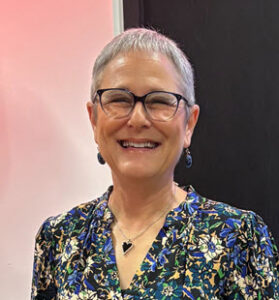
Barbara Giammona is a T1D diagnosed later in life. She worked in technical and corporate communication for nearly four decades. She is part of the founding team of T1Dto100. In retirement, she splits her time between homes in Southern California and the New Jersey Shore.
3 Comments
Submit a Comment
Recent Stories & News

Choosing Your 2027 Medicare Plan: An Open Enrollment Guide for People with Type 1 Diabetes
We have created this guide on how to choose your 2027 medicare plan including important dates, commons mistakes, and a checklist of things to do. There are also special insights on what you need to keep in mind, programs that could be helpful, and changes from the previous year. Read the full article for everything you need to know!
Intrinsic Capacity: The Most Important Longevity Term You’ve Probably Never Heard Of
Intrinsic Capacity is a new term experts are hoping to use to determine a person’s overall health in an effort to implement interventions for a longer, healthier, and happier life. Intrinsic Capacity is measured in five different key areas including cognition, locomotion, sensory capacity, psychological well-being, and vitality. Several studies are being implemented across the US to learn more on how to improve the accuracy of this metric and use it, eventually, for all ages.
LADA: Why So Many Adults Are Misdiagnosed With Type 2 Diabetes
A YouTube discussion from Taking Care of Your Diabetes (TCOYD) on why 4 in 10 people who are diagnosed with Latent Autoimmune Diabetes in Adults (LADA) are told they have Type 2 Diabetes first and the impact of this misdiagnosis on their health and progress.

Interview – An Endo’s View: From the Other Side of the Examination Table
I conducted the interview below with my own endocrinologist Dr. David Lam. Our first visit lasted 90 minutes. We talked about diabetes only the last half hour. Lam is smart, tech savvy and responsive. As you might have guessed he is also compassionate, prizes partnership, and sees me as a person, not merely a condition. My husband was impressed when Dr. Lam stayed in text-touch with me, switching me from Lantus to Tresiba, over a weekend. I wanted to understand how he sees our challenges aging with type 1 diabetes and the ones he faces every day working within our industrialized health care system. He didn’t hesitate when I asked for this interview, so here’s an endocrinologist’s view from the other side of the examination table.
The New Science of Brain Workouts, Beyond Sudoku and Crosswords
Forget holding hands—new research reveals a surprising twist in how two people can become a dynamic duo against sudden loss of balance. A recent study, published in the Journal of the Royal Society Interface, demonstrates that when two individuals walk side by side, a rigid link between them dramatically accelerates balance recovery after unexpected slips.
What a wonderful interview. Dorothy and her husband are incredibly nice people. So sorry they had to go through this but happy they were prepared and safe.
I’m so happy for this couple to have the beach place to hunker down in. I haven’t quite figured out where I would be heading to for safe haven.
I appreciate the reminder to keep rotating emergency supplies, and to put more thought into having more clothes and creature comforts. Love Dorothy’s PMA!
When I saw the cars abandoned along the roads in the Palisades fire I thought to myself, “How could I carry my stash of T1D supplies and all my other necessities I brought with me in the car?” I immediately switched my supplies to a rolling suitcase, which I could move more easily should I have to abandon my car.
LOVE your comment and calls to action!!! THANK YOU so much for sharing your thoughts and feelings!!!