

Aging with T1D: There’s Always Something to Laugh About
Brad Slaight is a comedian, actor, writer, producer, filmmaker, and all-around fun and funny guy. He’s also a T1D – creator of the Diabetes Hero Squad – who’s known for bringing a few laughs to our complicated lives. We sat down with Brad to find out more about what he’s up to and see what he has to say about aging with T1D.
T1Dto100.com: When you are a comedian, do people expect you to be funny all the time?
Brad: Comedians in general are always looking for that joke, or to entertain people.
I was at Thanksgiving dinner. A lot of people were there, and suddenly, the host says, “Brad’s a stand up comedian.” They all turned to look at me, and I was on.
But you have to also realize when you shouldn’t be “on.” Even at a doctor’s office, something will happen, and I’ll think of a funny line. If the Doc knows you’re a comedian, you can get away with it. But standing in line at a bank, that’s another matter!
T1Dto100.com: But not everyone has a sense of humor about diabetes….
Brad: I was in an airport once, and I had my little briefcase with me with diabetes stuff in it. I went to the restroom, and I went into the stall to discreetly check my blood sugar and to inject some insulin.
I came out, and there was this kid. He says to me, “What are you doing with a briefcase in there?”
I just said, “I have Type 1 diabetes, and I was being discreet while taking care of it in private. Don’t worry about it.” And I went on my way. So, a few minutes later, I’m sitting at the gate waiting for my flight and I see the TSA coming at me.
When I explained, they were cool about it. They explained that they have to check things when they are reported, and that crazy kid probably watched too many movies.
But they did look closely at the bag again. Afterwards, I really wanted to say something to the kid. But I held my tongue. I just wanted to get home, so I let it go.
But just to show that there is Karma in the universe, later, on the plane, I see this kid. He’s a couple rows ahead of me with his mother. In the middle of the flight, he gets up and goes into first class because there were a bunch of empty seats. And he sat down. The flight attendant went off on him! I just smiled to myself and thought, “Yeah, it’s all okay!”
T1Dto100.com: Tell us about your diagnosis.
Brad: I came from Michigan to Los Angeles with my brother in my 20s to chase the Hollywood/Comedy dream.
When I came out here, I weighed over 300 pounds. I wasn’t diabetic, but I also wasn’t too well. And hey man, this was Hollywood, right? So, the 300 pounds was going to be an issue.
I had a neighbor who ate macrobiotically – mostly vegetables and brown rice. When I complained of stomach problems, he offered to let me eat with him for a week or so to see if I would feel better.
And I thought, “This is strange food.” But I ate it. And it was weird. Suddenly, I lost the cravings that I had.
Growing up, I was on every diet. I was always fat. I’d go on a diet, lose weight, gain it back and more. But it’s easier to eat healthy out in California. I also started exercising every day. I quit smoking. Over time, I lost half of my body weight. I literally became half the man I used to be!
And then I got what I thought was the flu. I was shooting a TV pilot in Colorado, and I just felt really weird. So, I came home and I went to my doctor. I said, “You know, I think I’ve got some kind of weird flu. I can’t drink enough water. I’m peeing like a horse.”
He took some blood, comes back in to talk to me – talk about bedside manner! He said, “You got it, you got it bad.”
And I said, “What do I got?” And he explained it to me.
I said, “But I haven’t eaten any sugar in a couple years.”
And he says, “You got a lot to learn here.”
When I met with the dietician and explained how I already ate, and exercised, they said, “Don’t change a thing!”
T1Dto100.com: Do you still eat a macrobiotic diet?
Brad: I’ve adapted over the years. I am a pescatarian (I do not eat meat but do eat fish) now. I try to eat healthy and avoid sugar. But on set, there are not all the kinds of choices you might like. And I don’t have time to do all the cooking required for that strict of a diet. But I still eat healthy and don’t have the cravings I used to have. I used to eat almost a dozen donuts at a time. Now, I’m happy with one healthy muffin.
T1Dto100.com: How do you treat your diabetes? What is your care regimen?
Brad: I still do MDI and still test with finger sticks.
My doctor and I talk about changes, but this routine works well for me, and I am in good control, so I’ve never felt the need to change. I’ve worried that if I got a CGM, I’d be looking at it every five seconds. I’m anal and I think it would drive me crazy. I just prefer to be unattached (and hey, I’m single, too!).
I’m very low dose. I exercise a lot. Although this past year I had a ruptured Achilles and then I had two herniated discs. So, it’s been kind of a rough year. I had to adjust my routine because I couldn’t put any weight on my foot for more than five months. I live in a third-floor walk-up apartment! Thank goodness for all the things that can be delivered in our post-COVID world!
I spent a lot of time in my apartment writing. And now I’m back to exercising and walking five miles every day. I’m finally back.
T1Dto100.com: I’ve heard you express your thoughts on the search for a cure. You have talked about how much money is spent developing new tech for T1D and that the focus is moving away from the search for a cure.
Brad: I always try to make a point of saying I’m glad that the technology is there. It’s certainly saving lives and helping people with day-to-day control.
But I also always ask, “Can we find a cure?” My underlying statement has always been that I really do feel there’s somebody out there right now, like a Dr. Banting (who discovered insulin and later “gave away” his findings to the world) who is working in an underfunded lab somewhere who is going to discover the cure for humane reasons, not financial reasons.
Big Pharma and the tech companies have a financial incentive to create tech. They don’t have that same incentive to find a cure.
T1Dto100.com: Tell us about the Diabetes Hero Squad.
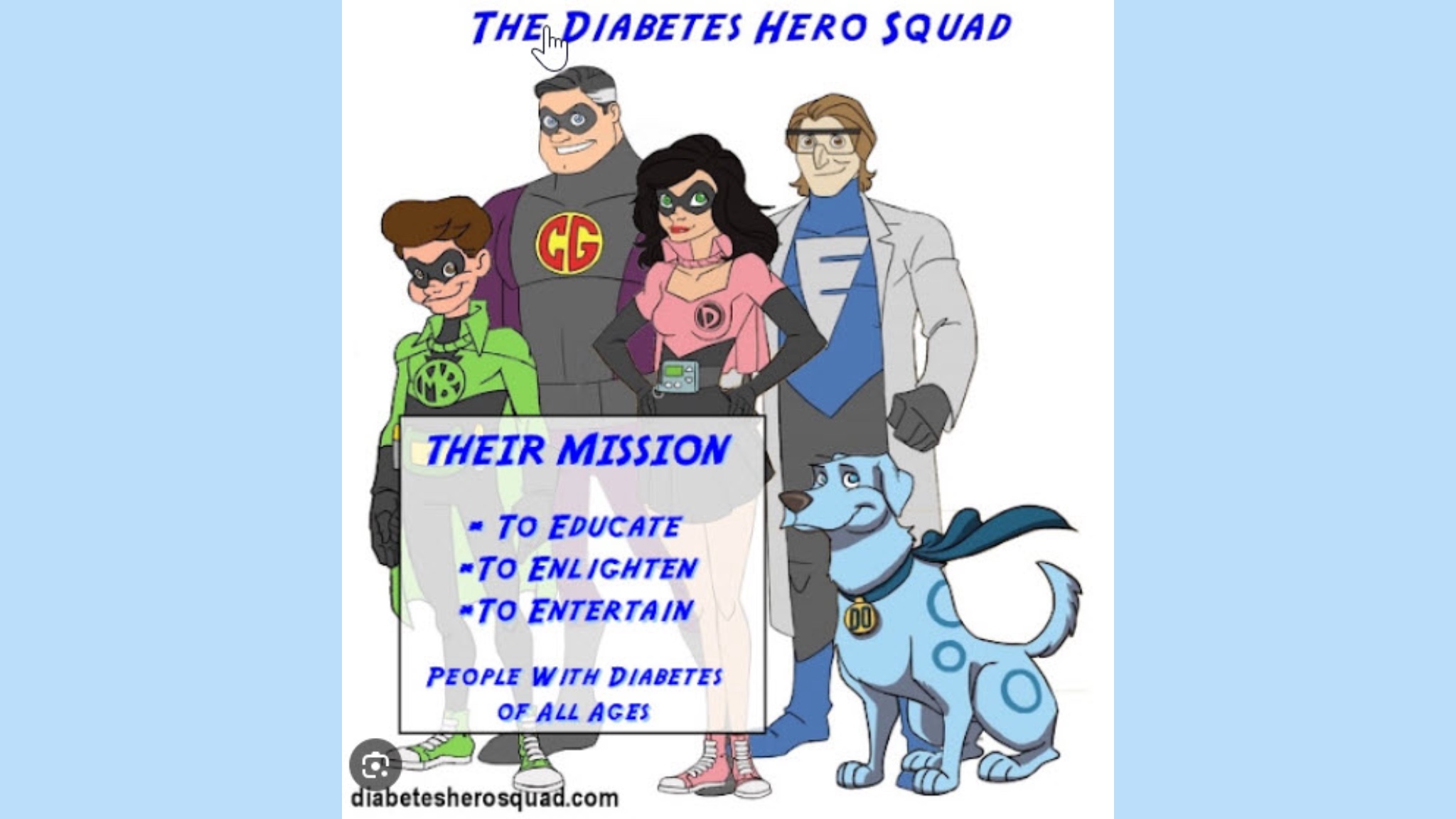
Brad: My friend Bill Kirchenbauer and I started the Diabetes Hero Squad because we wanted to give back in the way we knew best – using our talents as actors and comedians to help educate, enlighten, and entertain people of all ages who have diabetes. It’s “infotainment.” We wanted to offer an option to those scary educational materials everyone receives when they are first diagnosed – you all remember what that was like! That scared straight sort of thing: your eyes will explode; your legs will fall off. We go toward more of a “a spoonful of sugar approach,” pun intended!
We started with live action videos but switched to animated “cartoons” featuring characters such as Captain Glucose, Meter Boy, D-Girl, D-Oggie (the dog), and Amazing Endo, among others. We are not doing any active projects in that space right now, but we are proud of what we created.
T1Dto100.com: What are you working on today?
Brad: I create a lot of new memes and videos – stuff to make us laugh. I never make fun of diabetes itself. I make fun of the hurdles that we need to overcome and the day-to-day things we live with. I’ve always believed that in general, humor and laughter are like medicine. I call it “Humorlog.” It’s not quite as good as insulin, but I’ve always believed that when you laugh at something, you become the victor.
T1Dto100.com: So, what are you doing in your career as a performer right now?
Brad: I’ve always been kind of like a Hoover vacuum in show business. You have to have a lot of attachments but not suck like a Hoover. Some years I made a lot of money acting and I did a little bit of writing. Other years, I did a lot of writing and a little bit of acting. Doing standup is always just more of a luxury. I’m creating videos – those projects are for my own enjoyment. I’m in pre-production on a full-length screenplay that I wrote and will star in, along with others. We are considering doing it as animation because animation is so popular right now.
I always say that in show business, nobody retires. The phone doesn’t ring very much anymore, but you don’t retire. Your work is what you are. And it’s what turns you on. So, I will just keep on doing it.
T1Dto100.com: Did you ever have a “real job?”
Brad: I was a teacher for two years right out of college, and what scared me most about it was the idea of knowing exactly where I’d be in 30 years. As opposed to not knowing what I’m doing tomorrow. That excites me more! So, even when I’m a hundred years old, I’ll be sitting here coming up with a new meme or a video idea.
T1Dto100.com: A Hollywood question for you: What’s the worst depiction of type one diabetes you have ever seen in a movie or a television show?
Brad: Well, yeah, there are some classics, like “Con Air” which always confused me. The guy on the plane needed his insulin, but they made him kind of look like he was having a low; he was sweating and disoriented.
In “Panic Room” with Jodie Foster the daughter has a hypo, but the mother doesn’t just suggest to the intruder to just get the kid some juice! And then the daughter recovers way too quickly after receiving unnecessary Glucagon! I guess you can’t stop and do a Public Service Announcement in the middle of a movie to explain how it really works.
Some of my comedian friends will do a diabetes joke, the real easy ones, like, “Just smelling those cookies baking, I got diabetes.” And I always have the urge to correct them, especially if it’s somewhere public like Facebook. But maybe it’s better not to get into it.
I will educate people if they want to know about diabetes. Or if someone makes an inaccurate joke, I may say, “you know, that really isn’t true.” By now, most of my friends at least have learned the difference between type one and type two, you know, insulin deficient versus insulin resistant. Big difference! But we also do have a lot in common between the types. Don’t crowd us all together, but please have some empathy because both groups have their own problems. I always tell people, “The ‘bad kind’ of diabetes is called ‘DIABETES’…both types are bad.”
T1Dto100.com: What’s your biggest concern as you age with T1D?
Brad: Well, I always say I work in show business. So, we don’t talk much about age! Everybody’s forty and younger. And the other line I use is, “I’m somewhere between puberty and death; pick a number and stay with it.” But seriously, I think about aging a lot because I have had T1D long enough now to worry, even though I got it a little later in life.
My endo had the greatest line. She works in diabetes research. She said, “You will not die from diabetes, but you will die with diabetes.”
That made a lot of sense to me. People tell me that they don’t mind dying. But they don’t want to be chipped away. I don’t want to be taken in pieces. I don’t want to somebody to have to take care of me.
I don’t mind getting older. I can deal with my diabetes. Hopefully they’ll have a cure someday. If they don’t, I’ll continue doing what I do.
We’re all different: our bodies are different, our activity schedules are different, what we eat is different. But what is most important is that you find out what works for you and that you do it!
T1Dto100.com: So, Mr. Comedian, can we go out with a laugh?
Brad: Here’s a couple of one-liners:
I want a divorce from my diabetes…because after a brief honeymoon period, all we’ve been doing is fighting with each other.
My blood sugar was so high my CGM said, “One person at a time, please!”
I don’t want to walk a mile in your shoes I just want to borrow your pancreas for a while.

You can find Brad at his website, on Facebook, and on YouTube.
Here is the Diabetes Hero Squad website.
Recent Stories & News

Choosing Your 2027 Medicare Plan: An Open Enrollment Guide for People with Type 1 Diabetes
We have created this guide on how to choose your 2027 medicare plan including important dates, commons mistakes, and a checklist of things to do. There are also special insights on what you need to keep in mind, programs that could be helpful, and changes from the previous year. Read the full article for everything you need to know!
Intrinsic Capacity: The Most Important Longevity Term You’ve Probably Never Heard Of
Intrinsic Capacity is a new term experts are hoping to use to determine a person’s overall health in an effort to implement interventions for a longer, healthier, and happier life. Intrinsic Capacity is measured in five different key areas including cognition, locomotion, sensory capacity, psychological well-being, and vitality. Several studies are being implemented across the US to learn more on how to improve the accuracy of this metric and use it, eventually, for all ages.

LADA: Why So Many Adults Are Misdiagnosed With Type 2 Diabetes
A YouTube discussion from Taking Care of Your Diabetes (TCOYD) on why 4 in 10 people who are diagnosed with Latent Autoimmune Diabetes in Adults (LADA) are told they have Type 2 Diabetes first and the impact of this misdiagnosis on their health and progress.

Interview – An Endo’s View: From the Other Side of the Examination Table
I conducted the interview below with my own endocrinologist Dr. David Lam. Our first visit lasted 90 minutes. We talked about diabetes only the last half hour. Lam is smart, tech savvy and responsive. As you might have guessed he is also compassionate, prizes partnership, and sees me as a person, not merely a condition. My husband was impressed when Dr. Lam stayed in text-touch with me, switching me from Lantus to Tresiba, over a weekend. I wanted to understand how he sees our challenges aging with type 1 diabetes and the ones he faces every day working within our industrialized health care system. He didn’t hesitate when I asked for this interview, so here’s an endocrinologist’s view from the other side of the examination table.

The New Science of Brain Workouts, Beyond Sudoku and Crosswords
Forget holding hands—new research reveals a surprising twist in how two people can become a dynamic duo against sudden loss of balance. A recent study, published in the Journal of the Royal Society Interface, demonstrates that when two individuals walk side by side, a rigid link between them dramatically accelerates balance recovery after unexpected slips.
0 Comments